Main menu Close main menu Main menu Menu ×
News

Governing with Nature

Why we're giving nature legal standing and re-organising how we work in the climate era

Author: Annette Mees

Why we put nature on the board

When Lucy Rose Sollit, Creative Director of FutureEverything, came to me with the proposition to put Nature on the Board, it felt like the sort of steps FutureEverything should be taking – even though I wasn’t entirely sure what it would really mean. It felt like the kind of thing that is lovely to say but difficult to put into practice. But this is also a combination that I’m really drawn to; a vision that entices, feels important, and yet not fully defined. One of the reasons I became chair of FutureEverything is because the organisation has always brought new processes to artistry and artistry to new processes.

Lucy brought in questions about decision-making that accounts for voices we’ve learned not to hear – other forms of intelligence –  and what it might mean to govern an arts organisation as if the more-than-human world had a stake in it. This is how change begins; with courageous questions and a willingness to explore alternatives with rigour and care.
Why this matters

I have been working on what change looks like in the cultural sector for twenty-five years, watching organisations wrestle with the change they claim to want, but struggle to achieve. We are comfortable with conversation but less so with implementation. We like to sit on panels and attend committees, to write think pieces and to measure our impact with devotion. Yet fundamental structures remain unchanged. We wanted to approach Nature on the Board differently. We wanted to implement and embody change, not just talk about it. Not to continue doing what we are doing with a smaller carbon footprint, but to fundamentally shift our models.

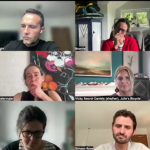
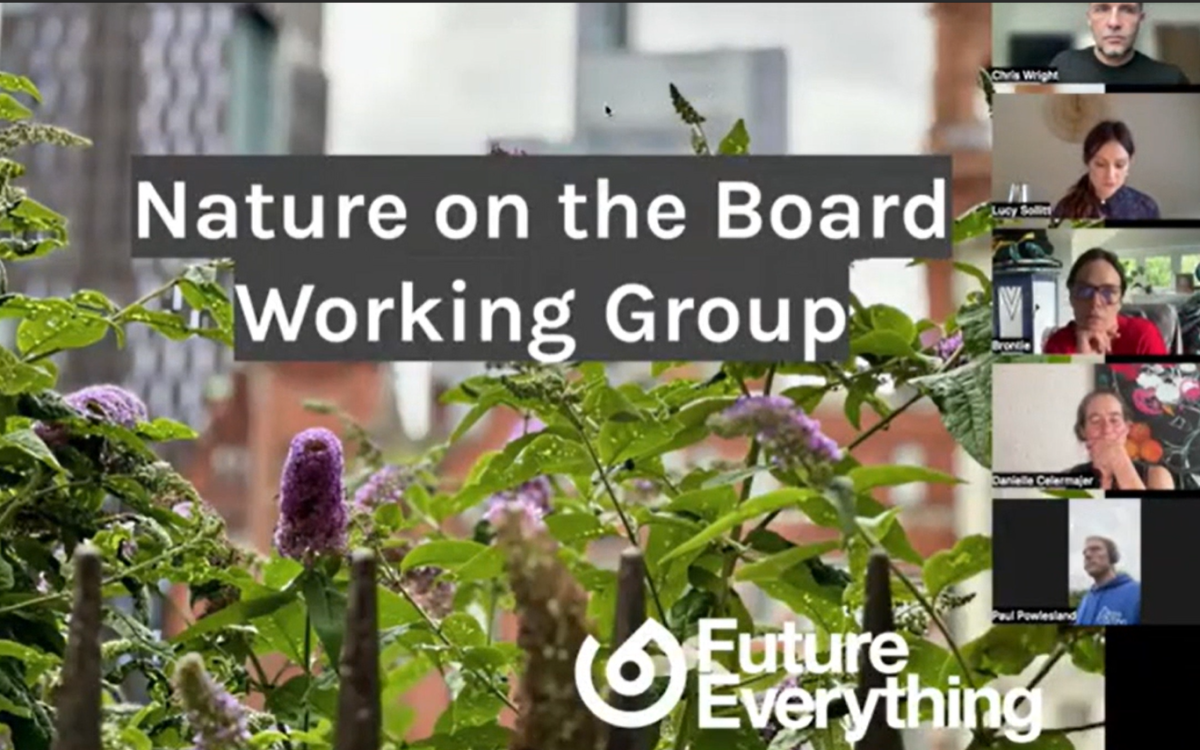
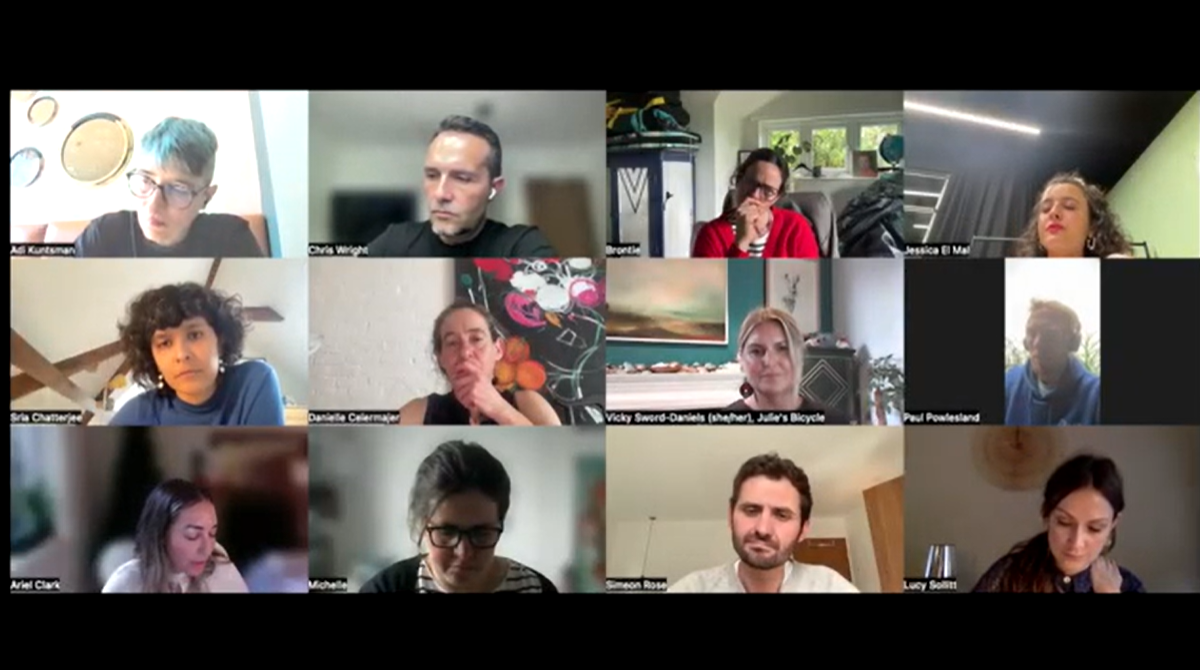
Lucy and our Nature Directed Working Group – comprising environmental lawyers, multi-species justice researchers, artists, and activists – began to articulate what many of us had felt, that our crisis isn’t just environmental but epistemological. That we don’t just need better policies but different ways of knowing. That intelligence, as James Bridle writes in “Ways of Being,” isn’t something you have but something you do. There are different knowledge systems all around us, in different cultures, in our collective history, but also in forests and rivers and soil.

For over 30 years, FutureEverything has brought people together to explore new ideas that dare to imagine better futures. As an organisation, we have always asked “what if?” – encouraging us to question assumptions, challenge perceptions and embrace new ways of imagining. 

Now that question turns inward: what if we brought these ideas into how we organise ourselves? How will it affect decision-making, our programme, and how we work with artists and partners?

What we are doing

Working with the amazing team at Lawyers for Nature we’re changing our Articles of Association to give Nature formal legal standing on our board. But honestly, the legal bit is the scaffolding, the real work is learning how to listen and act differently, both as a board and an organisation. 

When we appoint our Nature Director in Autumn 2025 we’ll start developing what we call “protocols of attunement” to help us ask different questions in dialogue with Nature. Together with the Nature Director (a human proxy that will represent Nature on the board) the team will embed these ideas into the organisational model through principles, and practices, which are being integrated across the Board and our artistic programme.

We see this as a first step in a journey of exploration and learning, which will keep evolving over years becoming an intrinsic part of everything we do. When conflicts arise (and they do, because this work invites us to hold unfamiliar tension, conflicts may inevitably arise), our processes and procedures will allow us to weigh ecological and sustainable concerns alongside artistic, financial and social impact.

What others can take from this

I’m very aware that this sounds like something only arts organisations would try. Maybe we are uniquely positioned because we’re used to working with imagination, with alternative ways of seeing. But any organisation serious about change has to start with the same question: how do our decisions affect the world and how do we change for the better? What values do we hold and what voices need to be amplified?

The governance framework we’re developing will be shared, so that others may follow in our footsteps. We want to contribute to a movement that includes Indigenous communities asserting rights of nature, lawyers crafting new possibilities, researchers developing frameworks for multispecies justice. We want to build strategic alliances as part of this wider movement, to be in dialogue with a larger community exploring these ideas, and create models that can be used by other organisations, in arts and culture and beyond.

Not everyone has to begin by changing their constitution. A gentler place to start is by asking: what perspectives are missing from your decision-making? Notice what you’ve been trained not to see or value, and begin introducing practices and models to shift that. Consider that ‘good practice’ might look very different from what you’ve been taught to expect. Be prepared for it to feel weird and uncomfortable – change usually does.

What Comes Next

At FutureEverything it felt like a step we could and should take. We won’t get this perfect from day one, but the question we keep returning to is: what becomes possible if we do things differently and begin to see nature as a core collaborator? We are learning a lot and we’re committed to sharing that learning generously. These questions feel urgent, but we also know that deep change takes time. We keep reminding ourselves that we are pathfinding, exploring off the beaten track, and asking questions without expecting immediate answers. We hope that in the process we start to discover things that we can’t yet imagine.

Over the next year we’ll be actively looking for board members with useful expertise and connections that can help this experiment flourish and expand. If that is you, do get in touch.

It feels exciting and profound,it won’t always be easy, but the alternative – carrying on with business as usual as if the world is not on fire – feels worse. I truly believe the arts can help us experiment with different ways of doing and being. I can’t wait to see what emerges.

Related Articles & Projects