Main menu Close main menu Main menu Menu ×
News

Putting Life at the centre: A conversation with Ariel Waagosh

Ariel Waagosh and Lucy Sollitt talk about working together on Nature Directed and practices of remembering and restoring our relationship with our human and more-than-human kin.

Conversation by Lucy Sollitt, FutureEverything Creative Director

Lucy Sollitt: We are incredibly grateful to have worked with you on Nature Directed. Your perspective, insights and encouragement has been fundamental to this work. 

Initially I hesitated about reaching out to you as I wasn’t sure if it would be appropriate to connect a place-based knowledge system from Anishinaabeaki and the Great Lakes of Turtle Island (the United States) to a Manchester-based organisation. I was also wary of inadvertently replicating ongoing legacies of colonialism and cultural appropriation. But having shared goals helped us collaborate across cultures and histories.

What has the experience been like for you? What advice might you have for others who are looking to work in this way.

Ariel Waagosh: From the beginning, working with FutureEverything – with you, and with your leadership – has been guided by care, thoughtfulness, and deep questioning. It’s been trust-building; and we’ve been moving through this process at the speed of trust. 

I have felt so impressed and grateful to have participated in a process where there is so much thoughtfulness and spaciousness – and that does not happen often within a Western framework, where deadlines and urgency tend to drive things, and that’s how we end up replicating the same things over and over. 

You know, the leadership of a project is so important, and the intentions that go into it. You can feel when someone is coming to it from a good place and we can just as easily feel when someone has a major agenda, when the hyper-individualist energy takes over and the focus becomes simply getting a job done. I always ask: where is this coming from? What is the prayer that’s being made – the intention that’s asking to be actualised?

There have been many human beings, for many hundreds of years, whose ways of relating to the land, the plants, and all of life is one of taking. I’m focused on world-building, on dreaming of what has been, and what can be, when we put life at the centre. 
“I’m focused on world-building, on dreaming of what has been, and what can be, when we put life at the centre.”

We’ve lived through cycles of violence and harm, and need to slow down to truly see its impact – on communities, on the world, and within ourselves. There is wisdom, and this wisdom is to be shared. As an Anishinaabe legal scholar and knowledge keeper once shared with me “we have our wisdom and our ways, and we traveled – we traveled the waterways, anywhere on this beautiful planet – and our relatives shared that wisdom.” So it’s good for our European brothers and sisters, and others, to ask. 

I’ve really appreciated that you’ve asked those questions, and I’ve really enjoyed and have been honoured to participate in this process of world-building, visioning and dreaming together. This experience has been healing for me, and knowing that you and the other Working Group members all exist and the work you’re doing has been really beautiful.

For those looking to approach this kind of work, I would say start within. Move with slowness and in a respectful way. Ask yourselves: How can we do this in a good way? What is the prayer we’re making? And remember that there is an energy exchange with this kind of work. Honor it.

“When you start to pay attention, when you start to acknowledge, you start to attune.”

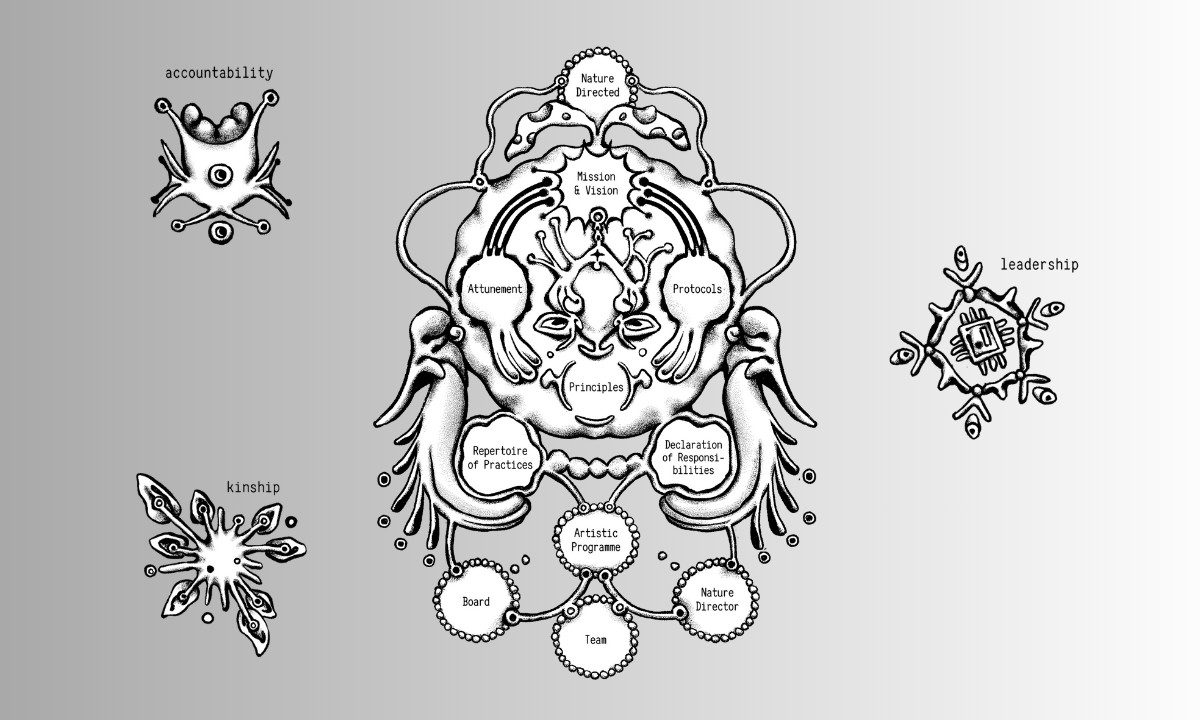
The practice of attuning is foundational to our Nature Directed model. By attuning, I mean an ongoing discipline of relearning how to pay attention and listen to our more-than-human kin in bodily, affective, intuitive ways, without any attempt at knowing or mastery. Attunement is key to how “Nature” participates in our organisation and is intrinsic to the practices and workflows we’ve developed. Ultimately, it’s about bringing ourselves back into relation and connection with the Web of Life.

How does attunement resonate with your own experience and practices?

I’d like to share an example that has been shared with me. Imagine you walk through a room and your parent is sitting there, your grandparent is sitting in the room, and you walk through the room and you don’t acknowledge them one day. And then you walk through the room again, and you just don’t acknowledge them for another day and more days and weeks, and then it’s years, and then it’s maybe hundreds of years. That is the experience of the trees, of the plants, of all of life that is out there, of the moon, of the sun, of the stars, of all of that, from our vantage point, is all interrelated, we are all related. 

When you start to pay attention, when you start to acknowledge, you start to attune. Whether or not we call it a “protocol” – a word that can sometimes feel loaded – we have living processes, ways of being that are grounded in acknowledgement, offering, and gratitude.

Would you share an example of one of your living processes of attuning with us?

For me, it’s a morning prayer, a song of gratitude. I use the word “prayer” as it’s a familiar word, but we actually never had the word for “prayer”, it’s a translation from before contact. Our language for this is sacred communication. For you, it might be meditation, a walk, touching the ground. You might light a candle – remembering that we all once sat around the same ancestral fire, or sit with water, without which we wouldn’t exist. It’s a practice of humility, of seeing ourselves and the sacredness of our lives. We wouldn’t be here without water, without the plants that feed us, without the animals, without the sun – it’s about returning, again and again, to that awareness. 

Beginning each day with a personal dedication helps return us to a place of connection. If we’re not attending to and acknowledging, if we don’t have processes that ground ourselves in our hearts and in our bodies, then we will do the same things habitually, repeat the same patterns even when our intentions are different. We have to centre ourselves so that we can have, as I’ve heard Haudenosaunee people say, a Good Mind, before starting the work.


“It’s like all of life listens and comes and stands behind you in your work.”

We practice this individually and in our communities. Before starting a project or before a meeting, we sit together in a circle and say good words first. We sing, we say prayer, and we say good words for the work we’re doing together, for our family, for the land, for the water, for all people, for peace on this earth, for us to come together and be our best selves, to be kind to each other. And when you say those words, it’s like all of life listens and comes and stands behind you in your work.

I’ve brought this practice into my work with a lawyer association I co-created: We have a few minutes of meditation, breathing, encouragement to feel your feet and get into your body. And if the person who leads it is someone who wants to say words or uses the word prayer, that is the offering. 

Do that for a month, and it will take you on a beautiful journey and you’ll feel better, because you’ll know that you are connected with all of life.

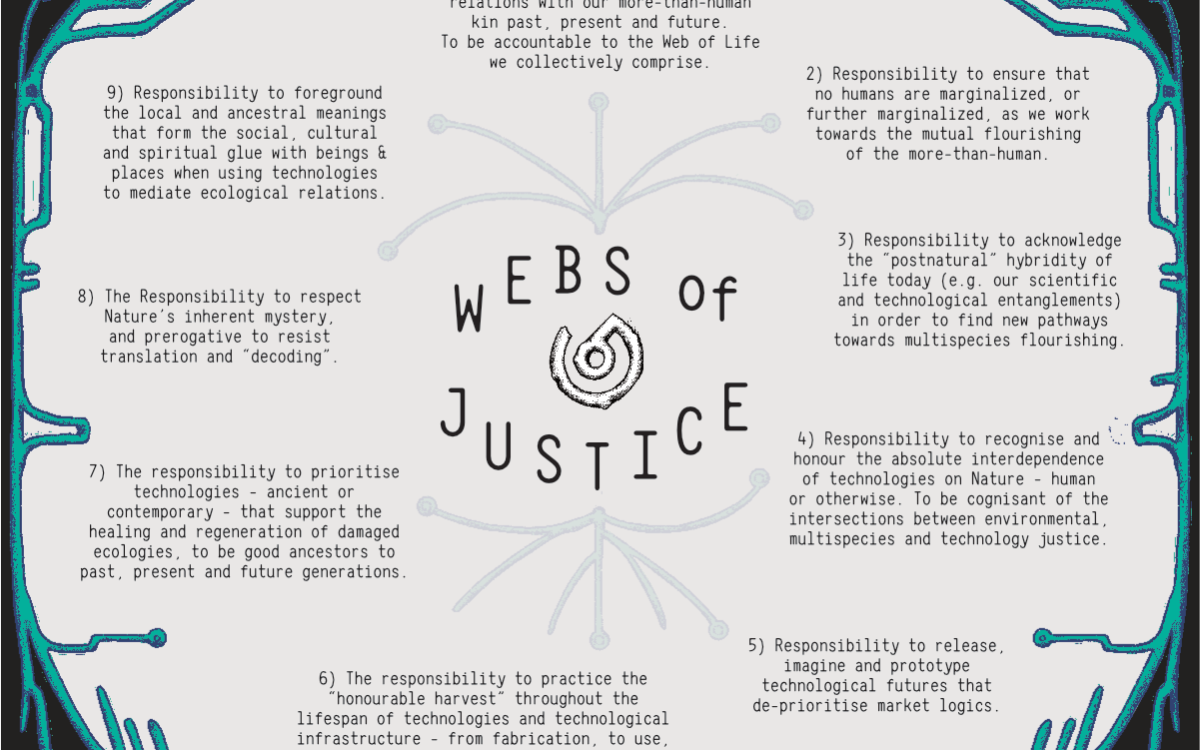
FutureEverything is experimenting with a shared recitation of a Declaration of Responsibilities, entitled Webs of Justice, at each of our key meetings as a team and Board. Regularly repeating this as a kind of shared ritual is a device for holding ourselves accountable and entering into dialogue the power dynamics, logics and practices that underpin the obstacles to change.

Conversations with you have been key to shaping this, for example, to using a Responsibility rather than Rights framework and the power of repetition and shared recitation. You’ve been inspired by the practices you use in your own community, as well as what you’ve learned from others. Can you expand on this?

The Declaration, again, feels like an embodiment practice, one of presencing and attuning, and one that bridges your work with art and technology, in the Nature Directed work. 

In my own community work, before we do any work together, we speak words of gratitude and acknowledgment, reminding us of the responsibility each of us has to all our kin and all life. I’ve learned so much from friends and Elders about ways to do this, some Anishinaabe and from other tribes as well. I’m not Haudenosaunee, they are neighbours to us, but I’m very inspired by the Haudenosaunee Great Law of Peace, a constitutional framework created centuries ago under the leadership of the Peacemaker. The Great Law of Peace is carried through ceremonial recitation and sets out a system of governance founded on unity, peace, and collective responsibility among the Haudenosaunee Confederacy, now composed of six nations.

Knowing that, as the Elder who named me says, all us human beings wake up selfish, so shared recitation and repetition is important, as those practices bring us into relation with our responsibilities. It reminds us that laws and declarations are not static texts, but living agreements that shape how we relate to one another and the world we are in. To me your Declaration of Responsibilities draws from a similar current of thought: that governance extends beyond human concerns to include the wider web of life and is not static but a living practice that you enter into.

“Laws and declarations are not static texts, but living agreements that shape how we relate to one another and the world we are in.”

When seeking to collaborate with our more-than-human kin as decision-makers with a say in what we do, it’s inevitable that conflict will arise. For example, as fermentation artist Kaajal Modi, points out the microbial kin that make up our bodies can be both beneficial and toxic to us. What methods do you use for managing conflict?

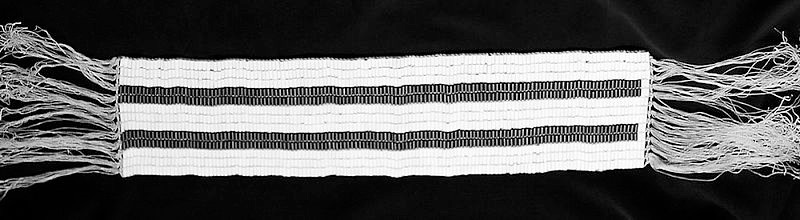
This is bridge work. To do bridge work, we need to create what scholars often talk about as a “third space”, that sacred space in between, where we can meet. I’ve heard Haudenosaunee (Oneida) lawyer and knowledge keeper Michelle Schenandoah speak about The Two Row Wampum Belt, a peace treaty made in the 1600s between the Dutch and the Haudenosaunee. I understand it as, among many other things, a promise of peace and mutual respect for each other’s communities and different ways of thinking and being.

On the shelled belt there are two parallel purple rows, one that represents the Dutch sailing ships and one that represents the Haudenosaunee canoes. I’ve heard Anishinaabe relational systems scholar, Melanie Goodchild talk about the centre white row as a third space, a sacred space between the two cultures where friendship and alliance can be built, but that is based on peace, friendship, and respect. I wonder if this third space is where we can move gradually from intellectual understanding to deeper emotional or spiritual learning and into respectful connection and sacred responsibility. 

But it’s also about unlearning. We live such busy lives, with constant meetings, agendas and deadlines; it’s important we ground ourselves in our hearts, before we use our minds. 

For example, when reading your Declaration as a team, I’d recommend sitting in a peacemaking circle and in the centre place a plant, some water, light a candle. The circle is important and the reason for the circle is the circle itself. Think about the atmosphere created by coloniality and harm – the “creation machine” of power-over paradigms. It’s the triangle, where a few people are at the top, and labour and resources are extracted and brought all the way to the top. So it’s very powerful when we then move and sit in a circle. The circle means no one is above anyone else, no one is outside of the circle, we embody the circle. 

Peacemaking circles are a traditional practice found in Indigenous communities around the world. The peacemakers I know, the Elders from our communities in Turtle Island, and also including Irish, Kenyan, and peacemakers from all over the world, all share this commitment to embodied practice and attunement – with each other and the Web of Life. 

Like with Nature Directed, working together in these ways, through these subtle acts, is what truly makes a difference. This is our human relational technology.

Related articles